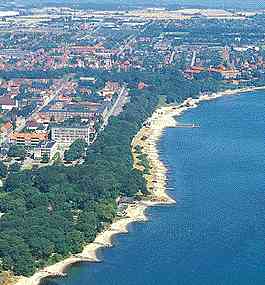
 You will find Fredericia Yachting Harbour on
55 degrees 33,2' N
9 degrees 43,8' E. The tide gate in Little Belt
There can be a very heavy current through the tide gate in Little Belt. Between 3 and 5 knots is not unusual, when there is breeze, and even in connection with relatively calm winds, the current usually run with up to several knots.
It is the wind direction which has the superior effect on the direction of the current, but also the drainage from the Baltic is of importance.
Especially during the spring, where there is a lot of excess water from the rivers, the northerly current can run with big power, but for the whole year it applies that the northerly current has bigger power than the southward.
The strong windings of the tide gate result in characteristic areas with coastal countercurrent, where the water is drawn in the opposite direction of the main current. During navigation in countercurrent it is possible to save time and fuel by using the coastal countercurrent. In a sailing race the using of the coastal countercurrent is a decisive factor.
During calm weather conditions there is no quite sure rules for the direction of the current and you have to dead reckoning a navigation mark when you get near to Little Belt.
Besides it is often possible to see the direction of the current on the surface of the sea. When wind and current go in the same direction, the surface is more calm than normally - when they go against eachother the waves are high, choppy and dense. Current dividing lines are easily seen.
With certainity wind from NE through S to SW results in northerly current, while wind from W and N may result in a southward current, but especially W wind shall be of big power to turn the current.
Also high- and low pressures over the Baltics come into play, due to the fact that e.g. a heavy high pressure will press the water out and result in a northerly current - strengthened by the fact that often the high pressure will result in E and S winds.
If you come from the north in countercurrent you will first stick along Røjle Klint to Strib Fyr. Here you cross the current and now follow the Jutland side under the new bridge and further on to the old bridge. Here you cross the current once again, so you stick close to Gals Klint and Fænø.
During navigation north you almost have to follow the same route in countercurrent. However you have to tack to the Funen side as soon as you have passed the new bridge due to the fact that with the southward current there is a heavy coastal countercurrent north along the coast against Strib Fyr. |



